We’ve all been there — standing in the middle of a room where every surface is cluttered, every corner hides a job, and you don’t know where to begin. That rising feeling in your chest? That’s overwhelm.
It’s common for just about everyone, though it’ll feel especially familiar if you’re dealing with stress or anxiety — or if you’re neurodivergent.
The good news is you don’t need to feel ready. You just need a way in. This isn’t about having a “perfectly tidy” home. This is about finding your rhythm so that you can create some peace and start to feel better about your space.
Here are some gentle, practical tips to help you get started — even when you feel completely stuck!
1. Just start
Easier said than done, I know. But overwhelm is often the fear that you can’t cope, and the fastest way to challenge that fear is to act. So don’t wait to feel ready, as that moment might not come.
Instead, take one small, imperfect action. Pick up the first thing you see. Toss that empty box. Wipe a surface. You don’t need motivation — you need motion.
Get that ball rolling…
—
Note that action is action, not planning. I know how appealing it is to sit and write lists on what needs to be done. You get that lovely dopamine hit and a sense of achievement. But lists don’t clear rooms. Tidying something will help clear a room. So do that. My next few tips will show you how..
—
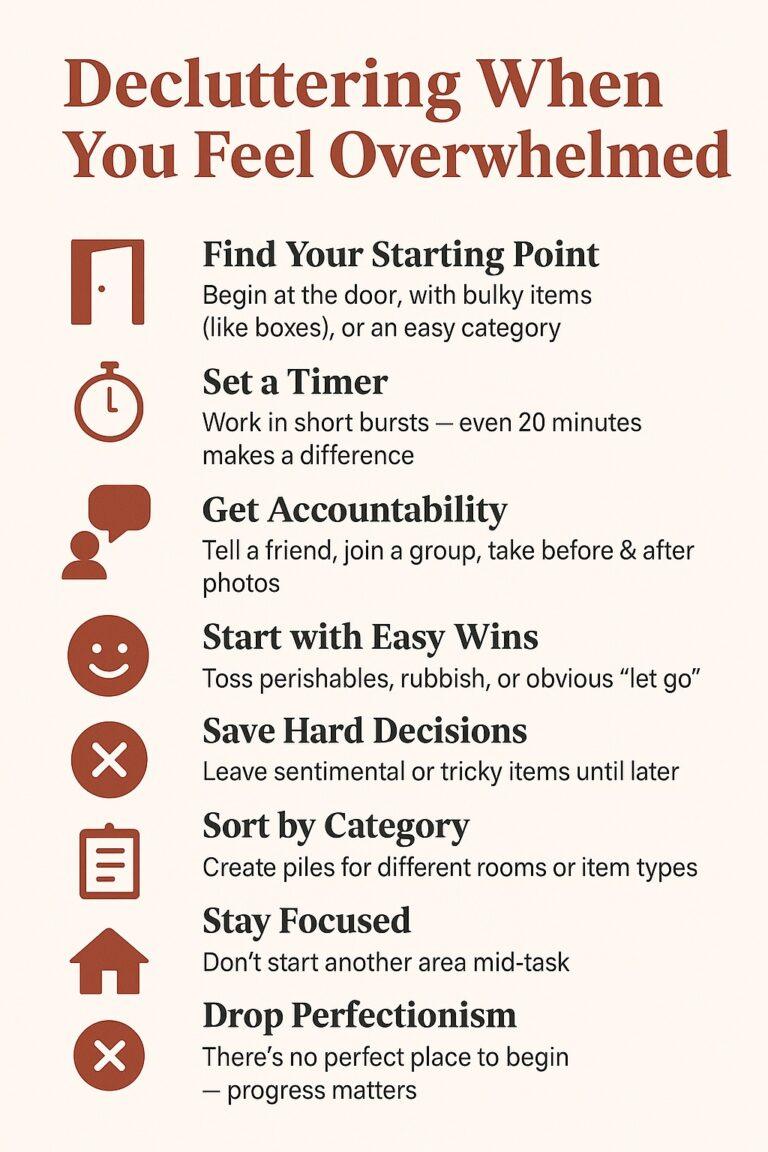
2. Choose a starting point that makes sense to you
There’s no perfect place to start. Truly. But having some kind of starting point helps your brain shift gears.
Here are a few options:
- Start at the entrance to the room and work your way clockwise.
- Begin with bulky items (like Amazon boxes or laundry piles) to clear visual space fast.
- Choose a category that feels easy — see some old bedding you know you’re not going to keep? That’s your start.
- Or begin with rubbish — if it’s broken, spoiled, or clearly going in the bin, out it goes.
Pick one — and off you go.
3. Set a timer (even just 20 minutes)
Often, we’re overwhelmed by the sheer volume of clutter and the fear that it will take forever to sort.
You don’t need to do it all in one go. In fact, please don’t — that’s a fast-track to burnout.
Set a timer for 20 or 30 minutes. That’s it. Just enough to build momentum without tipping into more stress. You can always reset it if you’re in the flow, but you don’t have to.
This is especially helpful if you’re managing energy dips, brain fog, or ADHD paralysis.
4. Get accountability (it helps more than you think)
Whether it’s texting a friend, posting in a Facebook group, or snapping a “before” picture, don’t go it alone. Share your goal, no matter how small: “I’m going to sort the toys for 20 minutes.”
Then, share an after. Not because your space needs to look perfect, but because you did something. It’s the action that counts.
5. Start with the easy wins
Quick wins are your secret weapon. Throw out the out-of-date fridge food. Toss the packaging you were “maybe going to reuse.” Recycle the stack of unread junk mail.
Each small decision makes the next one easier. Think of it as warming up your brain.
6. Delay the hard decisions
Sentimental items, things you feel guilty about getting rid of, paperwork that needs sorting — save those for later. You don’t need to tackle the hardest bits first.
Build momentum. Let the decisions get easier as your brain and body shift into gear. If you find yourself stuck on a decision, give yourself permission to move on to something else – the tricky stuff will become clearer as time goes on!
7. Tidy by category and create return piles
As you tidy, sort like with like. Make simple categories, such as:
- Toys
- Clothes
- Paperwork
- Books
- Things that belong in other rooms
Then make return piles to deal with at the end. Try to keep these separate so that when you’re done in this room, you can take the “living room pile” back all at once, without zigzagging and getting distracted.
The key is not to bung everything into one bag or box — it makes returning them harder, which means you’re more likely to put it off. If it’s too late and you’ve already chucked everything into a single box, check out my guide on how to tackle doom bags.
8. Don’t get distracted mid-sort (it happens to everyone)
One of the biggest traps is when you go to put something away — say, a pair of scissors — and then realise that drawer is a mess… so you start sorting that… and then the room next door… and suddenly your whole house feels worse. Sound familiar? This is so common and leads to stuff being everywhere, causing you to feel more overwhelmed and more likely to quit.
Stay in your zone. Don’t leave the room or space until it’s “done enough.” You’ll feel so much calmer that way. Your ‘return piles’ should help you to stay on track.
9. Drop the perfectionism
You don’t need a perfect home — just a functioning one. One that supports you.
Try to let go of the idea that there’s one “right” way to declutter, one “ideal” system, or that you have to finish the whole room in one go.
Progress over perfection. Always.
If you’re someone with ADHD or autism, you might recognise the urge to hyperfocus on one detail — like sorting a few items into a pretty storage box. Again, it’s that dopamine hit that makes this type of organising very appealing. But, for now, just group similar items and place them in the right general area.
You can reward yourself with top-tier organising later.
10. Motivation tip: use music, podcasts, or body doubling
Make it feel lighter. Put on a favourite playlist or an easy podcast, if background noise helps.
Or try body doubling — a technique especially helpful for people with ADHD — where you clean while someone else is nearby doing their own task, or even on a video call.
You’d be amazed how effective it can be.
A final word…
If you’re feeling overwhelmed, please know this: it’s not a personal failing. It’s not laziness. It’s a nervous system response.
The more you show yourself that you can take action — even in the smallest of ways — the more your brain and body will learn to trust that yes, you’ve got this.
You don’t need a full transformation. You just need a small shift in the right direction. So choose one area, set a timer, and begin. That’s enough for today.